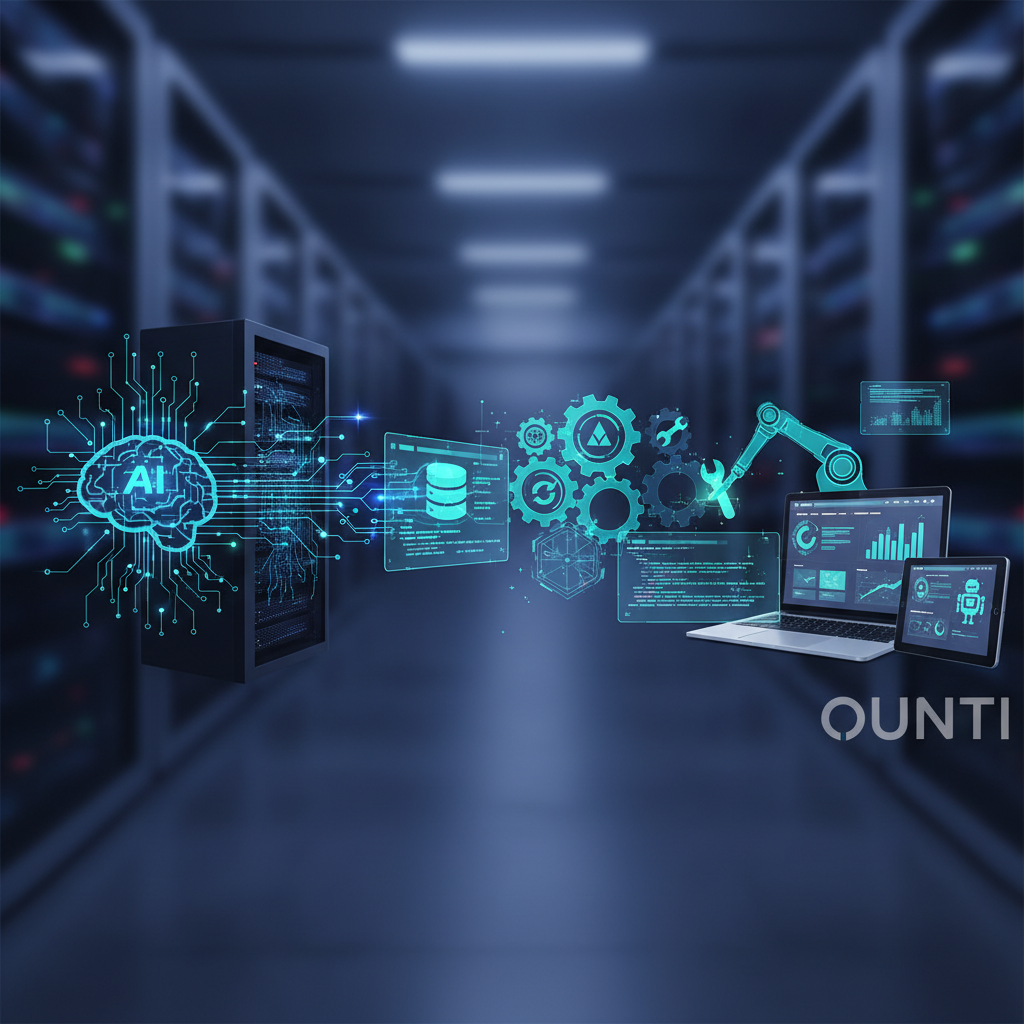
The digital landscape has shifted from a static collection of pages to a living, breathing organism that requires constant vigilance. For over a decade, I have witnessed the evolution of web management, from the early days of manual FTP uploads to the current era of complex CI/CD pipelines. Yet, the most significant leap we are currently navigating is the transition from manual oversight to intelligent autonomy. Integrating AI-powered maintenance task automation is no longer a luxury reserved for Silicon Valley giants; it is the new standard for any agency that values precision, uptime, and scalability.
In the traditional model, web maintenance was reactive. A plugin would break, a database would bloat, or a security vulnerability would be exploited, and then—and only then—would a developer intervene. This "break-fix" cycle is inherently inefficient and costly. As we scale operations at OUNTI, the focus has shifted toward predictive and self-healing systems. By leveraging machine learning algorithms and LLMs, we can now anticipate failures before they manifest, ensuring that the digital infrastructure remains robust without constant human micro-management.
The Technical Architecture of Self-Healing Systems
To understand the depth of AI-powered maintenance task automation, one must look past simple cron jobs. We are talking about neural networks capable of analyzing server logs in real-time to detect anomalous patterns that precede a DDoS attack or a memory leak. When these patterns are identified, the system doesn't just send an alert; it initiates a mitigation protocol. This might involve reconfiguring load balancers, clearing specific cache layers, or spinning up isolated instances to contain the threat.
For specialized niches, the requirements are even more stringent. For instance, when we develop a web para centros de yoga y pilates, the user experience depends on seamless scheduling and real-time streaming integrations. AI-driven scripts can monitor the API health of these third-party scheduling tools. If a latency spike is detected in the booking engine, the automation layer can temporarily switch to a lightweight fallback version of the site, ensuring that the business never loses a lead while the primary system recovers.
This level of sophistication is what separates a modern agency from a legacy one. It requires a deep understanding of both infrastructure and software logic. At OUNTI, we treat maintenance not as a chore, but as an ongoing optimization process where every automated task provides data back to the system to improve its future performance.
Predictive Patching and Security Governance
One of the most labor-intensive aspects of web development is the constant cycle of security updates. Historically, this involved testing updates in a staging environment, checking for regressions, and then deploying to production. With AI-powered maintenance task automation, this entire workflow is being revolutionized. AI agents can now perform "visual regression testing" with far greater accuracy than a human eye. They can compare thousands of pages in seconds, identifying if a CSS update shifted a button by three pixels in an obscure browser version.
Security is the cornerstone of our regional operations. Whether we are catering to the emerging digital markets and the specific regional demands in Caivano or working with international clients, the threat landscape is universal. AI-powered tools can scan code repositories for deprecated functions and automatically suggest (or apply) patches that align with current security headers. This proactive stance significantly reduces the "window of vulnerability" that exists between the discovery of a bug and its manual resolution.
Furthermore, these systems utilize advanced AI frameworks from leaders like Google Cloud to analyze global threat intelligence feeds. If a new vulnerability is discovered in a common PHP library, the automation system can instantly assess which of our managed sites are at risk and apply a virtual patch at the WAF (Web Application Firewall) level before the underlying software is even updated.
Database Optimization and Content Integrity
As websites age, their databases tend to accumulate "digital debt"—orphaned metadata, expired transients, and fragmented tables. In the past, a database administrator would run manual optimization queries. Today, AI-powered maintenance task automation handles this dynamically. Algorithms monitor query execution times and automatically index tables that are showing signs of slowing down. They can identify redundant data patterns and suggest archival strategies that keep the production database lean and fast.
This is particularly critical for high-traffic e-commerce platforms. Consider the complexity of managing a seamless tienda online de productos para mascotas with thousands of SKUs and fluctuating inventory. An AI system can manage the integrity of product data, identifying broken image links or mismatched pricing categories across various languages and currencies. It ensures that the database remains a source of truth rather than a bottleneck for performance.
The speed of a site is not just about the frontend; it’s about the health of the backend. By automating the cleaning and restructuring of data, we ensure that the Time to First Byte (TTFB) remains consistent regardless of how much the site grows. This is the "silent" work of AI that users never see but always feel through a snappy, responsive interface.
Local Relevance and Global Scalability
Working as a senior expert in this niche has taught me that technology must always be grounded in the local context of the business it serves. While the logic of AI-powered maintenance task automation is global, its application must be tailored. For example, when observing the refined design trends in Nápoles, we see a demand for high-fidelity visual content. Maintaining these heavy assets without compromising speed requires AI-driven image optimization and CDN (Content Delivery Network) purging strategies that adapt to local traffic spikes.
The beauty of automation lies in its ability to provide bespoke care at scale. We can apply the same rigorous security protocols to a local boutique as we do to a multinational corporation. The AI doesn't get tired, it doesn't overlook details during a late-night shift, and it doesn't suffer from "alert fatigue." It provides a consistent baseline of excellence that allows our creative teams to focus on what they do best: designing and building the next generation of digital experiences.
Looking forward, the role of the web developer is shifting from a "builder" to an "architect of systems." We are no longer just writing code; we are training the systems that will manage that code. This shift requires a new mindset—one that embraces the complexity of AI while maintaining the human intuition necessary to guide it. At OUNTI, we are not just observers of this change; we are the ones engineering the tools that make it possible.
The Human-in-the-Loop Necessity
Despite the power of AI-powered maintenance task automation, the "human-in-the-loop" philosophy remains vital. AI is exceptional at identifying patterns and executing repetitive tasks, but it lacks the strategic context of a business owner. It doesn't know that a client is planning a massive rebrand next month or that a specific legal regulation in a new market requires a change in data handling policies.
Our role as senior experts is to define the parameters within which the AI operates. We set the thresholds for what constitutes an "emergency" and what can be handled autonomously. We perform the final audits on the automated reports to ensure that the machine's "logic" aligns with the client's "vision." This synergy between human expertise and machine efficiency is where the real value lies. It allows us to offer maintenance packages that are not just about keeping the lights on, but about driving the business forward.
In conclusion, the integration of intelligent automation into web maintenance is a transformative force. It reduces operational overhead, eliminates human error, and provides a level of security that was previously unattainable. For agencies like OUNTI, it is the cornerstone of our promise to our clients: a digital presence that is not only beautiful and functional but also resilient, optimized, and future-proof.