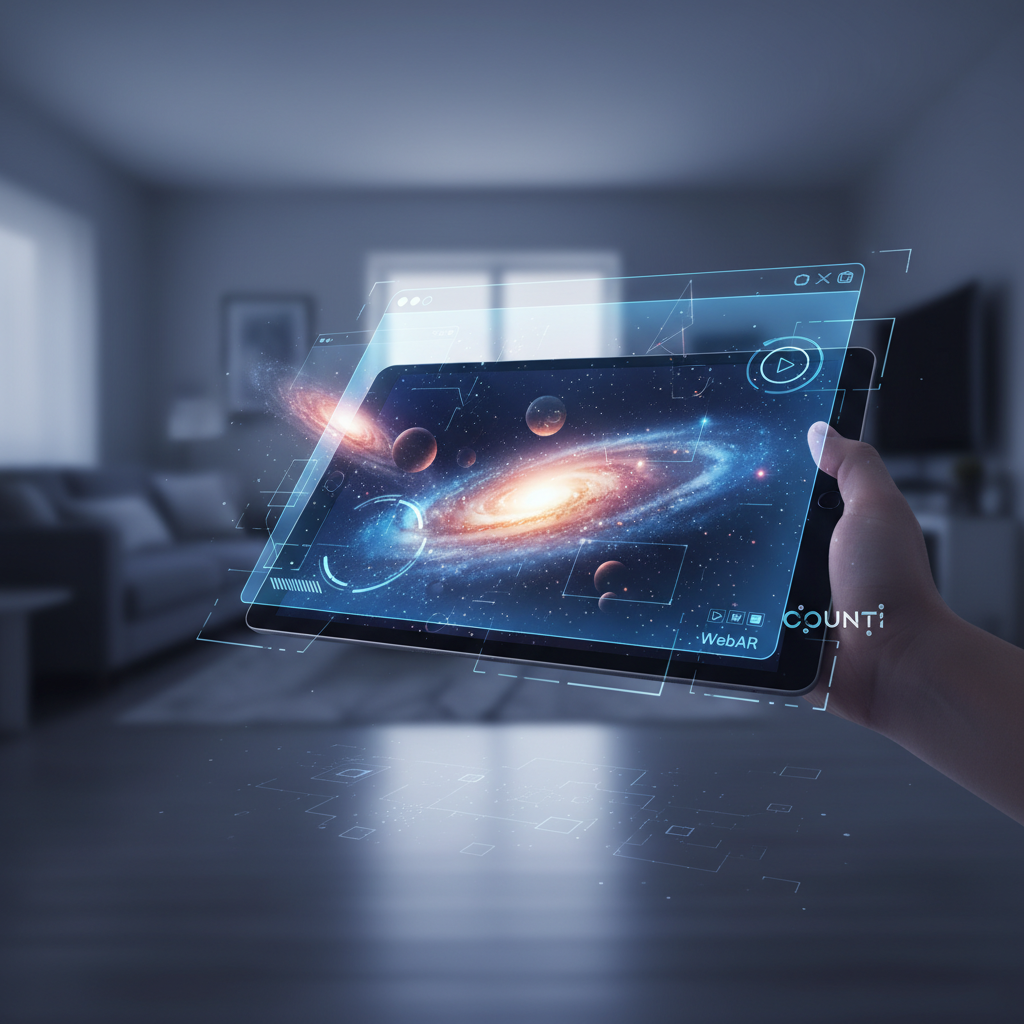
For over a decade, the promise of Augmented Reality (AR) was held hostage by the "Download Barrier." To experience a digital layer over the physical world, users were forced to navigate to an app store, wait for a multi-hundred-megabyte download, grant invasive permissions, and finally—provided they hadn't lost interest—view the content. As an agency that has navigated the technical shifts of the last ten years, OUNTI has observed a seismic shift. The friction of native apps has become the primary killer of conversion rates. Enter Web-based Augmented Reality (WebAR).
This technology leverages the browser—Chrome, Safari, or Firefox—to deliver immersive experiences without the intermediate step of an app. By utilizing the WebXR Device API and frameworks like Three.js or 8th Wall, we are now able to transform a standard smartphone into a window to a spatially aware digital universe. This isn't just a gimmick; it is the most significant evolution in user interface design since the transition from desktop to mobile. When we talk about Web-based Augmented Reality (WebAR), we are talking about the democratization of immersive technology.
Technical Architecture and the Death of Latency
In the early days of browser-based 3D, performance was a major bottleneck. We were limited by the processing power of mobile browsers and the lack of direct access to camera hardware. Today, the landscape is unrecognizable. Modern Web-based Augmented Reality (WebAR) utilizes WebAssembly (Wasm) to run complex computer vision algorithms at near-native speeds. This allows for real-time surface detection, image tracking, and even "Light Estimation," which ensures that digital objects are shaded correctly according to the real-world environment.
For developers, the challenge has shifted from "Can we do it?" to "How fast can we load it?" Optimization is the new frontier. Utilizing GLB and USDZ file formats, we can compress high-fidelity 3D models into fragments that stream over 4G and 5G connections seamlessly. The goal is an "instant-on" experience. When we implement web design for Almería-based businesses looking to modernize their digital presence, we prioritize these lightweight, high-impact assets to ensure that no user is left waiting for a spinning loader.
Furthermore, the integration of the WebXR Device API provides a standardized way for web content to access sensors, providing motion tracking and eye-level estimation. This standardization is what allows OUNTI to build once and deploy everywhere, bypassing the fragmentation of the Android and iOS ecosystems that once plagued the industry.
The Psychology of Frictionless Immersion
Why does Web-based Augmented Reality (WebAR) outperform native apps in marketing and retail? The answer lies in the "Point of Inspiration." When a consumer sees a QR code on a product package or a social media ad, their intent is at its peak. Every click and every second of waiting erodes that intent. By delivering the experience directly in the browser, we capture that momentum instantly.
Consider the emotional connection of seeing a product in one's own space. This "Endowment Effect"—the psychological phenomenon where people value things more highly because they feel a sense of ownership—is triggered much more effectively through AR. We have integrated these principles into various niche markets. For instance, when developing web design for flower delivery shops, allowing a customer to "place" a bouquet on their actual dining table via their phone camera eliminates the "will it fit?" or "how will it look?" anxiety that often prevents a sale.
Even in traditional markets, the digital expectation is rising. Our consultants providing web design in Velletri are increasingly seeing that even local boutique services are looking for ways to stand out. A physical store can only reach those who walk through the door, but a WebAR portal can bring that store's atmosphere to a user's living room halfway across the world.
Industry Disruption: From Retail to Heavy Industry
Web-based Augmented Reality (WebAR) is not limited to simple 3D models. We are seeing sophisticated "World Tracking" being used for virtual showrooms. In the automotive sector, the impact is staggering. Buying a car is a high-friction, high-anxiety process. By utilizing web design for car dealerships that includes WebAR, a potential buyer can explore a full-scale 3D model of a vehicle in their own driveway. They can change colors, swap rims, and even "step inside" to see the interior—all without leaving their browser.
This level of interaction moves the needle far beyond what a 2D gallery ever could. It creates a "sticky" experience. Users spend minutes instead of seconds interacting with the brand. In the B2B sector, WebAR is being used for "Remote Assistance" and "Instructional Overlays." Imagine a technician opening a web link to see a 3D visualization of a machine's internal components superimposed over the physical unit. No app installation required, no corporate IT barriers, just instant data visualization.
Overcoming the Constraints of the Browser
As experts with a decade in the field, we must be honest: Web-based Augmented Reality (WebAR) does have constraints compared to native ARKit or ARCore applications. Memory management is more restrictive in a browser environment. You cannot load a 500,000-polygon model with 4K textures and expect it to run smoothly on a mid-range device. This is where OUNTI’s expertise in technical art and optimization comes into play.
We utilize techniques like "PBR (Physically Based Rendering) lite" and baked lighting to simulate high-end visuals with minimal computational overhead. We also implement smart fallback systems. If a user’s device doesn't support full WebXR, we serve a high-quality 3D viewer. This ensures that the user experience is never broken, only "gracefully degraded." The focus is always on the user’s journey, ensuring that the technology serves the objective rather than the technology being the objective itself.
The Future: Spatial SEO and the Immersive Web
We are moving toward a "Spatial Web." Google has already begun experimenting with indexing 3D models in search results. Soon, SEO will not just be about keywords and meta tags; it will be about "Spatial Authority." How well does your 3D content interact with the real world? How accurate are your spatial anchors?
Web-based Augmented Reality (WebAR) is the gateway to this future. It bridges the gap between the flat, 2D internet we’ve known for thirty years and the 3D, immersive internet (often referred to as the Metaverse) that is currently being built. Brands that adopt WebAR today are not just following a trend; they are claiming their territory in the next iteration of the digital economy. At OUNTI, we don't just build websites; we build environments. We understand that the browser is no longer a static document viewer—it is a powerful lens through which the digital and physical worlds converge.
The transition to Web-based Augmented Reality (WebAR) is inevitable. As hardware continues to improve and 5G becomes the global standard, the distinction between a "website" and an "experience" will vanish. The question for your business is not whether you need AR, but whether you can afford to let your competitors be the ones who remove the friction of the physical world for your customers first.