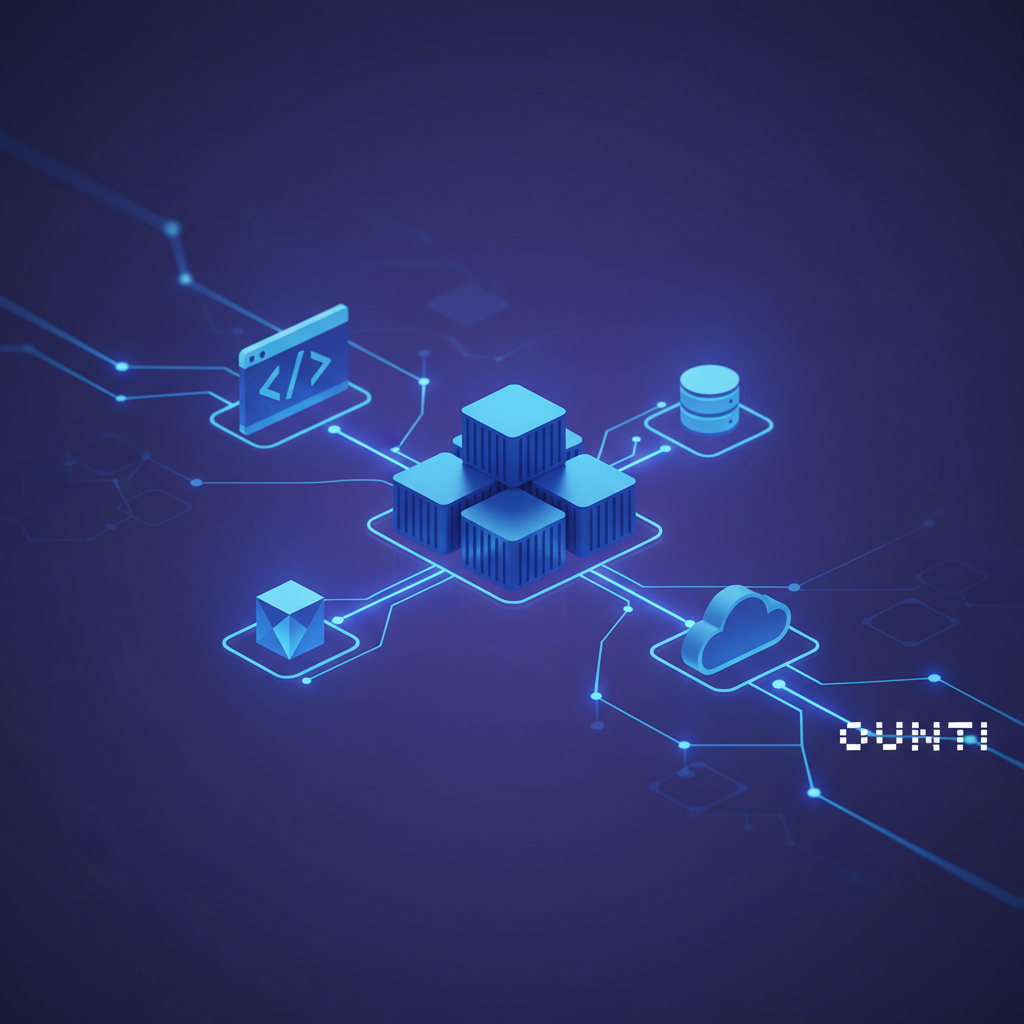
In the high-stakes world of full-stack development, the mantra "it works on my machine" has long been the bane of productivity. At OUNTI, we have spent over a decade refining our workflows to eliminate the discrepancies between local environments and production servers. The evolution from heavy virtual machines to lightweight containerization has not just been a trend; it has been a fundamental shift in how we architect, build, and deploy digital products. By prioritizing the integration of container technology, we ensure that every line of code behaves identically, whether it is running on a developer's laptop or a high-traffic cloud cluster.
The core philosophy of using Docker containers in development lies in the concept of process isolation. Unlike traditional virtualization, which requires a full guest operating system for every instance, containers share the host’s kernel while maintaining isolated user spaces. This efficiency allows our team to run complex stacks—comprising Nginx, PHP-FPM, PostgreSQL, Redis, and Node.js—without the overhead that would typically cripple a standard workstation. For a senior architect, the beauty of this system is the predictability it introduces into the software development lifecycle (SDLC).
Eliminating the Environment Friction
When we take on a project involving complex logistics, such as a specialized web design for educational toy stores, the technical requirements can be diverse. Such platforms often require integration with inventory management systems, real-time stock updates, and interactive front-ends. Without containerization, setting up a local environment for a new developer could take days. They would need to manually install specific versions of databases and runtime environments, often leading to "version hell."
By leveraging Docker, we define the environment as code. A single docker-compose.yml file becomes the source of truth. This file specifies every service, volume mount, and network configuration required for the application to function. When a new engineer joins the project, a simple command brings up the entire ecosystem in minutes. This level of standardization is what allows us to maintain high velocity without sacrificing code quality.
Furthermore, the immutability of Docker images means that the exact same artifact tested by our QA team is the one that gets pushed to production. This "build once, run anywhere" capability is the cornerstone of modern DevOps. It drastically reduces the risk of deployment failures caused by missing dependencies or slight variations in server configurations across different geographical regions.
Global Scalability and Regional Localization
OUNTI operates on a global scale, catering to diverse markets with specific infrastructure needs. Whether we are optimizing a platform for the European market or focusing on a specific web design project in Spain, the underlying architecture must be robust yet flexible. Containerization allows us to simulate regional latency and localized server configurations right within our local dev environments.
For instance, when designing for specific Mediterranean hubs, our team might need to account for localized caching strategies or specific CDN configurations. Our developers working on digital design solutions in Pozzuoli can spin up localized environments that mirror the production settings of our Italian clients. This geographical agility is only possible because containers abstract away the underlying hardware, allowing us to focus on the application logic and user experience.
According to the official Docker documentation, containers provide a logical packaging mechanism in which applications can be abstracted from the environment in which they actually run. This abstraction is vital when we are dealing with diverse stacks. We can run a legacy Python 2.7 app alongside a modern Go microservice on the same machine without any library conflicts, a scenario that was a nightmare in the pre-container era.
Optimizing Niche Industrial Solutions
The versatility of using Docker containers in development extends beyond general e-commerce. It is particularly effective when building technical platforms for the service industry. Consider the complexity of a web design for HVAC companies. These projects often require sophisticated calculators for energy efficiency, booking systems that sync with external APIs, and high-performance lead generation forms.
In these scenarios, the "development" phase is not just about aesthetics; it is about data integrity and processing power. Using Docker, we can create a "sidecar" container that mocks the external HVAC manufacturer APIs. This allows our developers to test edge cases—like API timeouts or malformed data—without needing access to the actual live production third-party systems. This sandboxed approach ensures that the final product is resilient and ready for the real-world stresses of the HVAC industry.
Moreover, the use of Docker volumes ensures that database persistence is handled correctly during development. We can share anonymized production datasets with developers by simply mounting a data volume, allowing them to work with realistic data volumes without compromising security or cluttering their local file systems. This level of sophisticated data management is a hallmark of a senior-led development agency.
The Future of Web Development Workflows
Looking forward, the integration of Docker into our daily workflow is just the beginning. We are moving toward "Remote Containers" and "Cloud Development Environments" (CDEs). By hosting our Dockerized development environments on powerful remote servers, we can give our developers even more resources while keeping the local footprint minimal. This is especially useful when compiling large assets or running intensive automated test suites that involve multiple browser instances.
The security benefits of containerization cannot be overstated either. Each container acts as a sandbox. If a developer accidentally pulls a malicious dependency during a test, the blast radius is limited to that specific container, protecting the host machine and the wider network. In an era where supply chain attacks are on the rise, this isolation is a critical layer of defense that we provide for all our clients, regardless of their industry.
Ultimately, the decision to use Docker is a decision to invest in reliability. It signifies a transition from manual, error-prone setup processes to an automated, reproducible, and scalable methodology. At OUNTI, our decade of experience has taught us that the tools we use define the quality of the products we deliver. By mastering containerization, we don't just build websites; we engineer robust digital infrastructures that grow with our clients' businesses. The consistency we achieve through Docker is what allows us to deliver world-class web design and development services across Spain, Italy, and beyond, ensuring that every project we touch is built on a foundation of technical excellence.
The shift towards microservices and serverless architectures further validates our commitment to containers. As applications become more modular, the ability to manage each component as a discrete unit becomes essential. Docker provides the common language that allows our designers, developers, and systems engineers to collaborate seamlessly, ensuring that the creative vision is never limited by technical constraints.