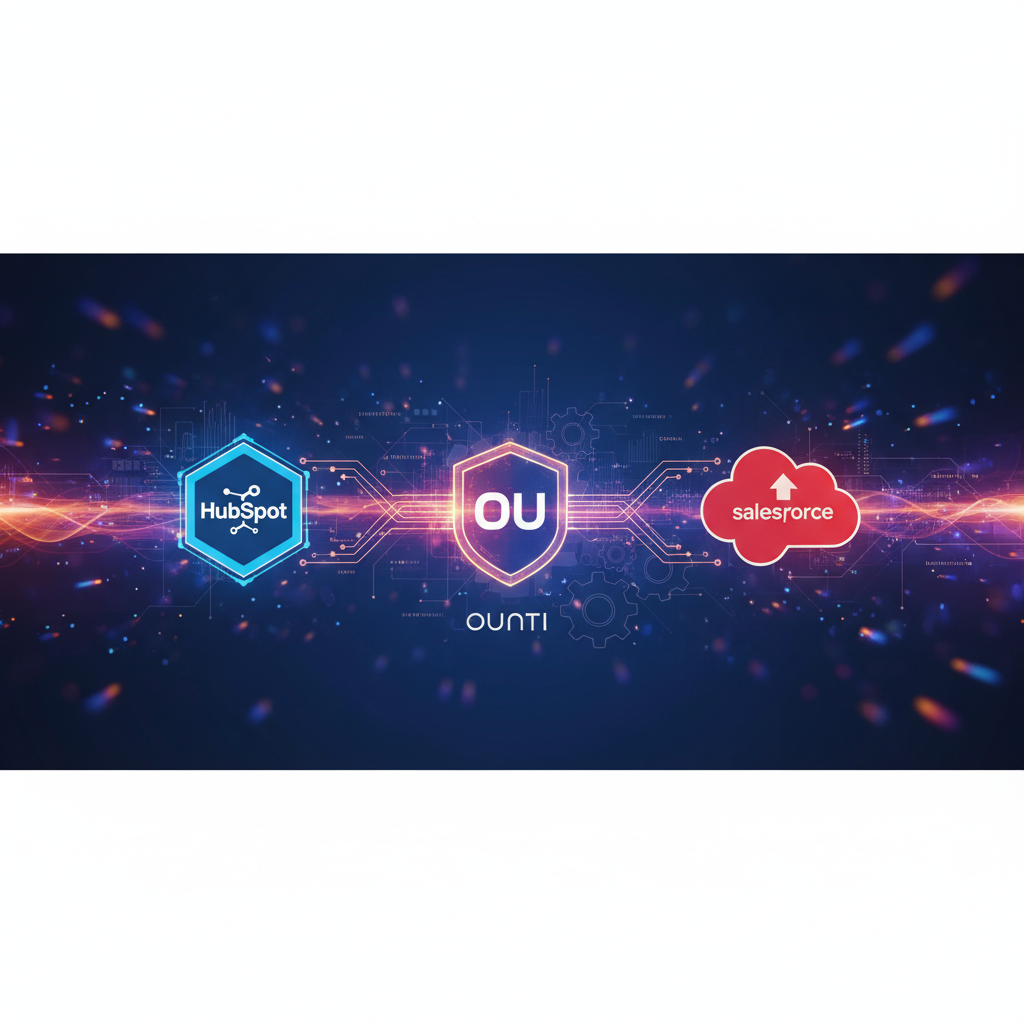
In the last decade of engineering digital solutions at OUNTI, I have witnessed a fundamental shift in how businesses perceive their web presence. The website is no longer a digital brochure; it is the front-end of a sophisticated data engine. When we discuss CRM Integration (HubSpot, Salesforce), we are not merely talking about connecting a contact form to a database. We are talking about the technical orchestration of lead intelligence, customer lifecycle management, and the elimination of data silos that stifle growth.
The Fallacy of the Out-of-the-Box Connection
Many agencies approach CRM Integration (HubSpot, Salesforce) as a secondary task—a plugin installation or a simple API key exchange. Ten years in this sector have taught me that this "surface-level" approach is where technical debt begins. A true integration requires a deep understanding of the CRM’s schema and the business’s unique sales funnel. Whether we are building a complex portal or a streamlined site for a specific region, such as our work in Caivano, the data architecture must be the foundation, not an afterthought.
HubSpot and Salesforce operate on different philosophies. HubSpot is built on a unified codebase designed for ease of use and marketing automation. Salesforce, conversely, is a highly customizable platform that requires rigorous governance and often, custom Apex coding or sophisticated Flow triggers. Choosing between them—or integrating both into a hybrid stack—requires an expert hand to ensure that every click on the front-end translates into a meaningful data point in the back-end.
To understand the depth of these platforms, one should consult the Salesforce Developer Documentation, which illustrates the sheer complexity of managing enterprise-level data objects and their relationships. At OUNTI, we treat these documentations as the blueprints for our custom API wrappers, ensuring that our clients' websites can "talk" to their CRMs without latency or data loss.
Bridging the Gap Between UX and Lead Intelligence
User experience (UX) is often discussed in terms of aesthetics and navigation, but in a conversion-focused environment, UX is the gateway to data. When we develop a web for boutique hotels, the integration must be invisible yet omniscient. A guest checking availability or signing up for a loyalty program should trigger a cascade of events in the CRM: lead scoring based on room preference, automated follow-up emails, and segmenting the user for future marketing campaigns.
This level of CRM Integration (HubSpot, Salesforce) prevents "leaky buckets." Without a deep integration, a user might interact with three different pages and fill out two forms, only for the CRM to see them as three separate, disconnected entities. Our methodology involves implementing advanced tracking via webhooks and custom objects to ensure a 360-degree view of the customer from their first visit to their most recent purchase.
Technical Hurdles: Mapping, Middleware, and Security
The complexity of CRM Integration (HubSpot, Salesforce) often manifests in field mapping. Standard fields like "Name" and "Email" are easy, but what about custom properties that drive your specific business logic? In our expansion into markets like Torrevieja, we see businesses struggling with local data regulations and the need for multi-language data handling within their CRM. The technical challenge is to map these variables across the API without creating conflicts.
Middleware often becomes necessary when the native integration capabilities of a CMS fall short. Whether using Zapier for simple tasks or building custom AWS Lambda functions for heavy-duty data transformation, the goal is always the same: data integrity. We must ensure that OAuth2 authentication protocols are strictly followed to protect sensitive customer data, especially when handling financial or educational information.
Consider the requirements for web design for nursery schools. Here, the CRM doesn't just manage leads; it manages trust. Parents are submitting sensitive information about their children. The CRM Integration (HubSpot, Salesforce) must be hardened against vulnerabilities while ensuring that the school’s administration receives organized, actionable data to manage admissions and communications effectively.
Bidirectional Sync: The Holy Grail of Sales and Marketing Alignment
The most common failure point I see in CRM setups is the "one-way street." Information goes from the website to the CRM, but nothing comes back. A senior-level CRM Integration (HubSpot, Salesforce) should be bidirectional. If a salesperson updates a lead's status to "Qualified" in Salesforce, the website should be able to recognize that returning user and serve them personalized content or a different call-to-action (CTA).
This creates a dynamic loop. In HubSpot, this is often achieved through Smart Content and lists. In Salesforce, it might require a more robust Experience Cloud setup or a custom-built headless CMS integration. By closing this loop, OUNTI helps businesses move away from generic marketing and toward high-conversion personalization. This isn't just a technical achievement; it is a competitive advantage that transforms the website into a proactive member of the sales team.
Scaling for the Future: Why Architecture Matters Now
Looking ahead, the role of CRM Integration (HubSpot, Salesforce) will only become more critical as AI and machine learning become standard in lead processing. If your data is messy today, your AI-driven insights will be useless tomorrow. We build with the next five years in mind, ensuring that the schemas we design today can support the predictive analytics of the future.
As an agency, OUNTI focuses on the long-term viability of these connections. We don't just "connect" tools; we build ecosystems where data flows seamlessly, securely, and strategically. Whether you are a local business or a global enterprise, the quality of your CRM integration will determine your ability to scale. It is the difference between struggling with spreadsheets and operating a precision-tuned revenue engine.
The investment in high-level integration is an investment in your business’s nervous system. When the website, the marketing automation, and the sales database act as one, the friction of growth disappears. That is the standard we hold at OUNTI, and it is what we deliver to every client, regardless of their industry or location.