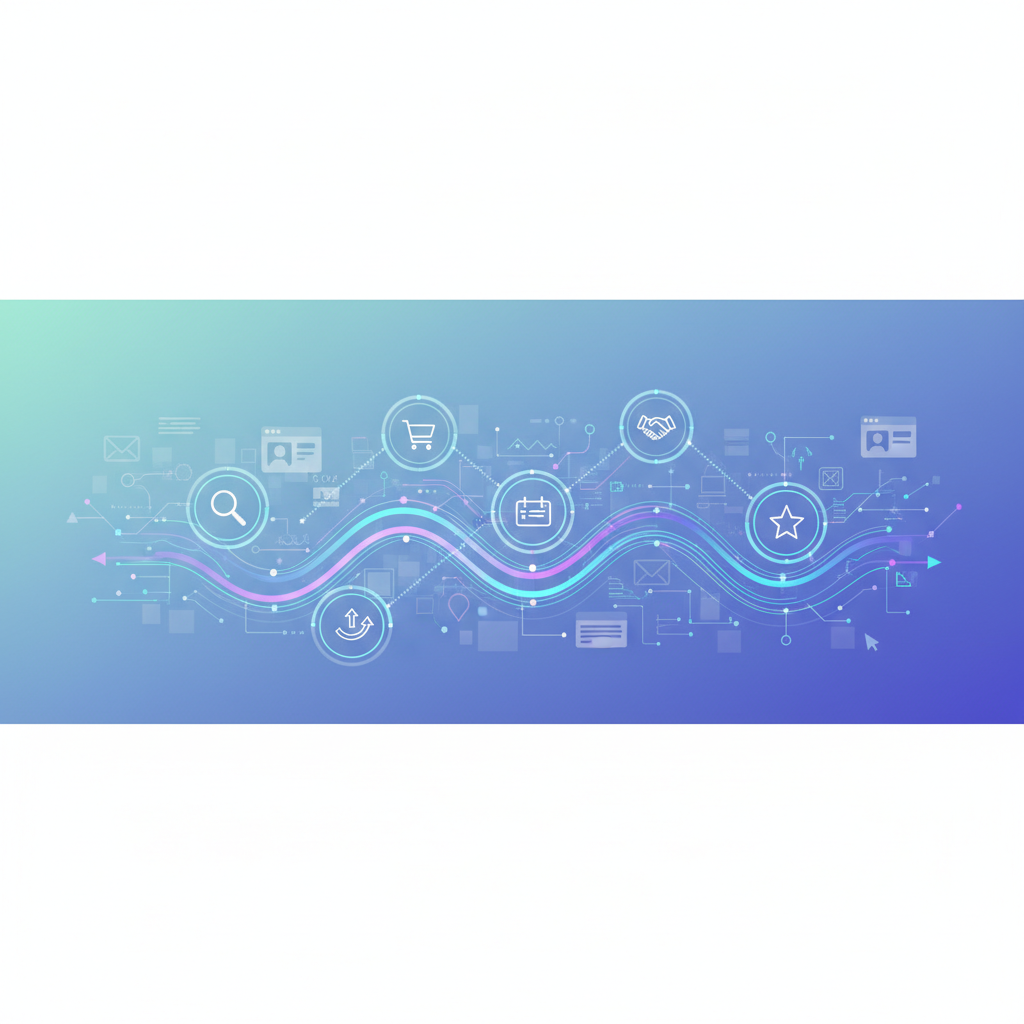
In the early days of web development, the focus was almost entirely on aesthetics and basic functionality. We built digital brochures rather than interactive experiences. However, after a decade in the trenches of high-end web design at OUNTI, the paradigm has shifted entirely. Today, a successful website is not a destination; it is a vehicle. To understand how a user moves from curiosity to conversion, we must master the Customer Journey Map on the web. This is not merely a marketing exercise; it is a fundamental architectural blueprint that dictates every line of code and every pixel we place.
When we talk about a Customer Journey Map on the web, we are discussing the visualization of the process a person goes through to accomplish a goal on your site. It encompasses every touchpoint, from the initial organic search result to the post-purchase confirmation page. For a design agency, the challenge lies in aligning the business’s technical capabilities with the user’s psychological state at each specific stage. If the journey is fragmented, the user drops off. If the journey is seamless, the brand disappears into the utility of the experience, which is the ultimate goal of high-level UX design.
Psychological Trigger Points and Behavioral Mapping
Every click is a decision influenced by cognitive load and motivation. When constructing a Customer Journey Map on the web, we begin by identifying the "moments of truth." These are the instances where a user decides to either proceed or bounce. In our experience at OUNTI, these moments often happen in the first three seconds of a page load. If the visual hierarchy does not immediately answer the user’s subconscious questions—"Am I in the right place?" and "Can I trust this?"—the journey ends before it begins.
To map this effectively, we use data-driven personas. We don't look at generic demographics; we look at "jobs to be done." For instance, the journey for someone seeking urgent home repairs is vastly different from someone looking for a long-term B2B partnership. For those in the trades, we have seen that a streamlined web design for plumbing companies requires a journey map that prioritizes immediate contact and trust signals like certifications and live reviews. The friction points must be non-existent because the user is often in a high-stress situation.
On the other hand, service-based industries that rely on recurring trust, such as maintenance, require a journey that emphasizes transparency and ease of scheduling. We have implemented strategies where the web design for cleaning services focuses on a journey map that guides the user through a custom quote calculator, reducing the psychological barrier of "hidden costs." By anticipating the user's need for pricing clarity, we shorten the path to conversion.
Technical Integration of the Mapping Process
A sophisticated Customer Journey Map on the web must be translated into technical specifications. This involves more than just a site map; it involves event tracking, heatmapping, and funnel analysis. We utilize tools like Nielsen Norman Group’s methodologies to ensure that our mapping isn't just theoretical. We look at "drop-off" reports to identify where the technical implementation fails the journey map. Is a form too long? Is a CTA (Call to Action) hidden behind a heavy image? Is the mobile responsiveness hindering the checkout flow?
The technical architecture must support the narrative. If our map indicates that a user needs educational content before they are ready to buy, the site’s internal linking structure must reflect that. It’s about creating a "scent of information" that the user can follow. This is particularly relevant when targeting specific geographical markets. For example, when optimizing a digital presence in Torre-Pacheco, the journey map must account for local search intent and regional language nuances that build immediate rapport with the local community.
Similarly, the digital landscape in competitive coastal areas requires a different tactical approach. When we manage projects for local SEO strategies in Torremolinos, the customer journey map often begins with a heavy emphasis on mobile-first discovery. Tourists and residents alike are searching on the go; therefore, the journey map prioritizes "near me" signals and rapid-load landing pages that deliver value within two taps.
The Evolution of Touchpoints: From Awareness to Advocacy
The journey does not end at the "Thank You" page. A sophisticated Customer Journey Map on the web includes the retention and advocacy phases. At OUNTI, we believe that the post-conversion experience is where brand loyalty is forged. This includes automated follow-up sequences, personalized dashboard experiences, and easy-to-access support channels. Each of these is a digital touchpoint that must be mapped with the same rigor as the sales landing page.
We often see businesses making the mistake of treating the web journey as a linear funnel. In reality, it is often a "messy middle"—a web of exploration and evaluation. A user might visit your site five times from three different devices before converting. Our job is to ensure that the Customer Journey Map on the web accounts for this cross-device behavior. State persistence, retargeting pixels, and consistent UI/UX across platforms ensure that the journey remains coherent, regardless of where the user picks it back up.
Advanced mapping also involves "friction logging." This is the practice of intentionally finding the most annoying parts of your own website. By documenting these hurdles within the journey map, we can prioritize development sprints that have the highest impact on ROI. It’s not about adding more features; it’s about removing the obstacles that prevent the user from reaching their goal. Whether it is a slow database query or a confusing navigation menu, every technical debt is a roadblock in the customer journey.
The Future of Web Mapping: Personalization and AI
Looking ahead, the Customer Journey Map on the web is becoming dynamic. We are moving away from static paths toward AI-driven experiences where the site morphs based on user behavior in real-time. If a user spends three minutes on a pricing page, the site might dynamically serve a testimonial or a live chat prompt. This is the "living" journey map.
However, the core principles of human-centric design remain. No matter how much technology we integrate, the map must always respect the user's time and intent. As experts with a decade of experience, OUNTI focuses on the intersection of data and empathy. We use the data to see what users are doing, but we use empathy to understand why they are doing it. That "why" is the heart of every successful Customer Journey Map on the web.
In conclusion, building a website without a journey map is like building a house without a floor plan. You might end up with walls and a roof, but the flow will be disastrous, and the inhabitants will eventually leave out of frustration. By meticulously planning every interaction, identifying every pain point, and optimizing every technical touchpoint, we transform websites from passive digital assets into active engines of business growth. The journey is the product, and mastering it is the only way to remain competitive in an increasingly crowded digital marketplace.