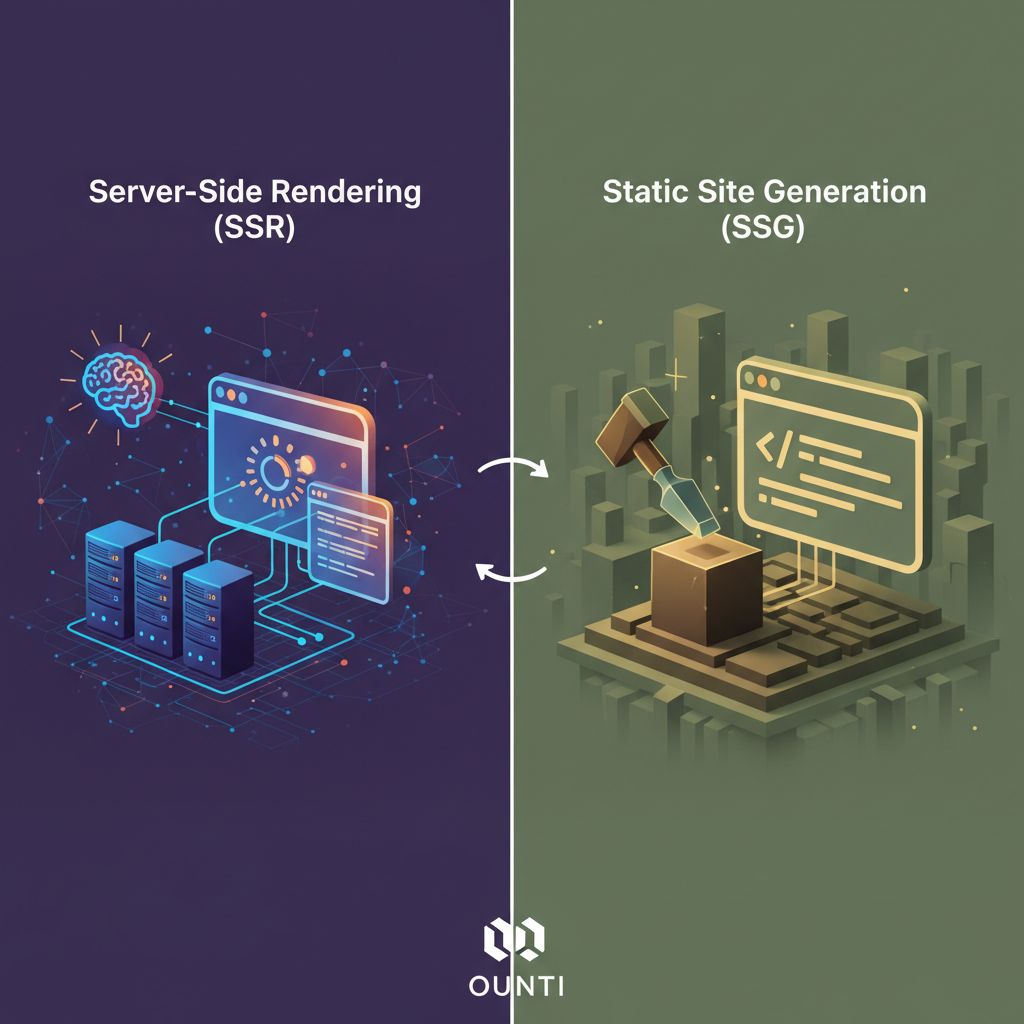
In the last decade of engineering web experiences at OUNTI, we have witnessed a seismic shift in how data travels from a server to a user's screen. The early days of the web were dominated by simple static files, which eventually gave way to heavy, server-heavy monolithic applications. Then came the era of Client-Side Rendering (CSR), which promised fluid interfaces but often sacrificed initial load speeds and search engine visibility. Today, the conversation has matured. As architects, we no longer ask if a site should be dynamic; we ask where and when that dynamism should be rendered. This brings us to the core debate: Server-Side Rendering (SSR) vs. Static Site Generation (SSG).
Choosing between these two methodologies is not merely a technical preference; it is a strategic business decision that impacts SEO, server costs, and user retention. Whether we are developing a high-performance web design solution in Sant Adrià de Besòs or building a complex infrastructure for international clients, the rendering strategy dictates the longevity of the digital product.
The Mechanics of Server-Side Rendering (SSR)
Server-Side Rendering is the process where every request to a website triggers a fresh generation of the HTML page on the server. When a user navigates to a URL, the server fetches the necessary data from a database, populates the HTML template, and sends a fully formed page back to the browser. This ensures that the user—and more importantly, search engine crawlers—receive the content immediately without waiting for JavaScript to execute.
The primary advantage of SSR is its ability to handle highly dynamic data that changes frequently. For instance, an e-commerce platform with real-time inventory levels or a social media feed requires the most up-to-date information at every refresh. By rendering on the server, we ensure that the user never sees stale data. However, this comes at a cost. Every request places a load on the CPU of the server, and the Time to First Byte (TTFB) can be higher because the server must "work" before it can send anything back.
For specialized niches, such as professional web design for driving schools, SSR can be beneficial if there are complex booking systems or real-time schedule availability that must be reflected accurately to avoid double bookings. In this scenario, the trade-off of a slightly slower TTFB is worth the guarantee of data integrity.
The Efficiency of Static Site Generation (SSG)
Static Site Generation operates on a different philosophy. Instead of waiting for a user to request a page, SSG renders all possible pages at build time. The result is a collection of static HTML, CSS, and JavaScript files that can be hosted on a Content Delivery Network (CDN). When a user requests a page, the CDN serves the pre-rendered file instantly.
The performance benefits of SSG are unparalleled. Because there is no database query or server-side logic happening at the moment of the request, the TTFB is incredibly low. This makes SSG the gold standard for performance-driven sites. Furthermore, since there is no active server-side processing for each visitor, the site is significantly more secure and scales effortlessly to millions of users without increasing infrastructure costs.
We often recommend this approach for informational hubs or corporate sites. For example, when crafting a bespoke web for digital transformation consultants, where content is updated periodically rather than every second, SSG provides a lightning-fast experience that mirrors the efficiency the consultants themselves advocate for. It creates a "locked-down" environment where security vulnerabilities are minimized because there is no live application server to exploit.
Performance Metrics and Core Web Vitals
To truly understand the impact of Server-Side Rendering (SSR) vs. Static Site Generation (SSG), we must look at how Google evaluates performance. The introduction of Core Web Vitals has made it clear: Largest Contentful Paint (LCP) and First Input Delay (FID) are critical for rankings. SSG typically wins on LCP because the browser receives the content almost the instant the connection is made. However, modern SSR frameworks have closed this gap significantly using streaming techniques.
According to the technical documentation on Google Web Dev rendering patterns, the choice between these methods should be guided by the "spectrum of interactivity." If your site is content-heavy with low interactivity, SSG is the winner. If it is a complex application with private user data, SSR (or even CSR) becomes necessary. The "Hydration" process—where a static or server-rendered page becomes a fully interactive React or Vue app in the browser—is where many developers fail to optimize. Over-hydration can lead to a "Uncanny Valley" effect where the page looks ready but doesn't respond to clicks, a common pitfall we avoid at OUNTI by using partial hydration or "Islands" architecture.
The Hybrid Approach: Incremental Static Regeneration (ISR)
As an agency with a decade of experience, we know that the world isn't binary. It is rarely just about choosing one over the other. The modern solution is often a hybrid approach. Incremental Static Regeneration (ISR) allows us to have the benefits of SSG while updating specific pages in the background as data changes, without rebuilding the entire site. This is particularly useful for large-scale deployments where a full build might take 30 minutes, but a price change needs to be live in seconds.
Consider a multinational project, perhaps one requiring localized design and development in Capannori. A hybrid model allows the main marketing pages to be served as static files for maximum speed across Europe, while the client portal or real-time analytics dashboards are rendered via SSR to ensure security and data freshness. This "best of both worlds" strategy is how we ensure that performance doesn't come at the expense of functionality.
Security, Scalability, and Maintenance Costs
From an operational standpoint, the Server-Side Rendering (SSR) vs. Static Site Generation (SSG) debate shifts toward Total Cost of Ownership (TCO). SSR requires a running Node.js (or similar) environment 24/7. It requires load balancers, auto-scaling groups, and constant monitoring to prevent crashes during traffic spikes. This infrastructure is not only more expensive but also requires more expert hours to maintain.
SSG, by contrast, reduces the "attack surface." Since the front-end is just a set of files on a CDN, there is no database connection to intercept on the client-facing side. Scalability is handled by the CDN provider (like Cloudflare or Vercel), meaning a sudden mention in a major news outlet won't bring the site down. For small to medium enterprises, this reduction in overhead is a massive competitive advantage, allowing them to redirect their budget from server maintenance to content marketing and UX improvements.
Making the Final Decision
When we sit down with a client at OUNTI, we audit their content lifecycle before writing a single line of code. We ask: How often does your data change? Does the content need to be personalized for each user at the first load? What is the technical literacy of the team managing the backend?
If the answer involves high-frequency updates and user-specific dashboards, SSR is the path. If the goal is high-speed content delivery, superior SEO for a blog or portfolio, and low maintenance, SSG is the undisputed champion. The modern web developer's role is no longer just to build, but to architect the flow of data in a way that balances the needs of the server, the browser, and the end user. By mastering the nuances of Server-Side Rendering (SSR) vs. Static Site Generation (SSG), we don't just build websites; we build high-performance assets that drive growth.